

Basic Knowledge of Non-Contact Thermometers
What is Emissivity?
Amount of Infrared Ray Emitted by Objects
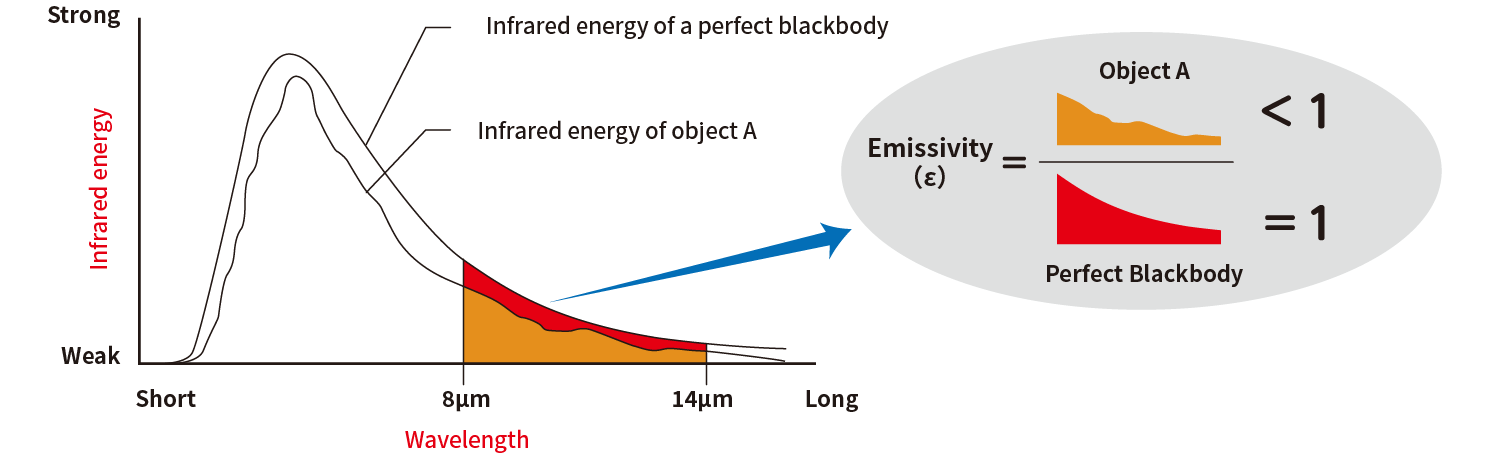
Emissivity is expressed on a scale from 0 to 1 and represents the proportion of infrared energy emitted.
The emissivity of an object is defined using a perfect blackbody (emissivity = 1) as the standard. The closer the value is to 1, the more sensitive the temperature measurement.
What is a Perfect Blackbody?
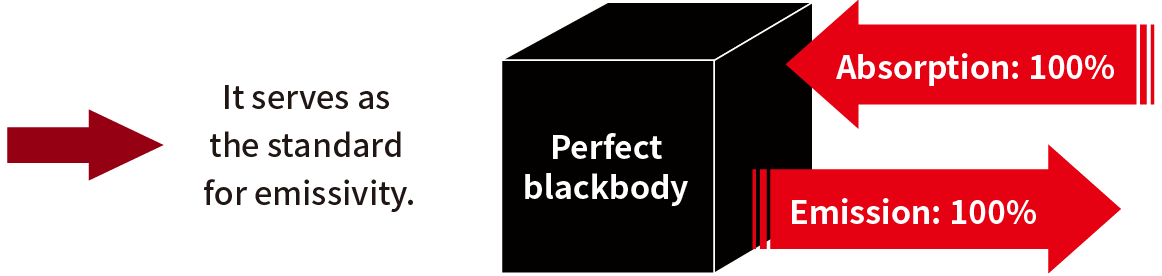
A perfect blackbody is an object that completely absorbs all light and reflects no external light.
How to Check Emissivity
Emissivity differs depending on the material. To measure temperature with high sensitivity, the wavelength at which emissivity is the highest must be used as the measurement wavelength.
In the Case of Iron
| Wavelength | 1 μm |
5.1 μm | 8 ... 14 μm |
|---|---|---|---|
| Emissivity | 0.35 |
0.05 ... 0.25 | 0.05 ... 0.2 |
At a wavelength of 1 μm, the emissivity is higher than at other wavelengths.
Note: Actual emissivity will vary depending on the surface condition and temperature of the material.
|
In the case of iron, the wavelength with the highest emissivity is 1.0 μm. |
General-purpose non-contact (radiation) thermometers use wavelengths of 8 to 14 μm and can measure most objects. However, when measuring metals as described above, more stable measurements can be achieved by detecting at shorter wavelengths. Furthermore, when measuring materials such as high-temperature metals, shiny metals, films, and glass, stable measurements can be achieved by detecting at wavelengths appropriate for each material.
- Download List
- 20