


LED Lighting Controller with Ethernet Connectivity
OPPD-30 Series
Easy Ethernet connectivity



- Mitsubishi Electric iQSS support
- Automatic brightness management

Simplify lighting control with an Ethernet-connectable compact controller
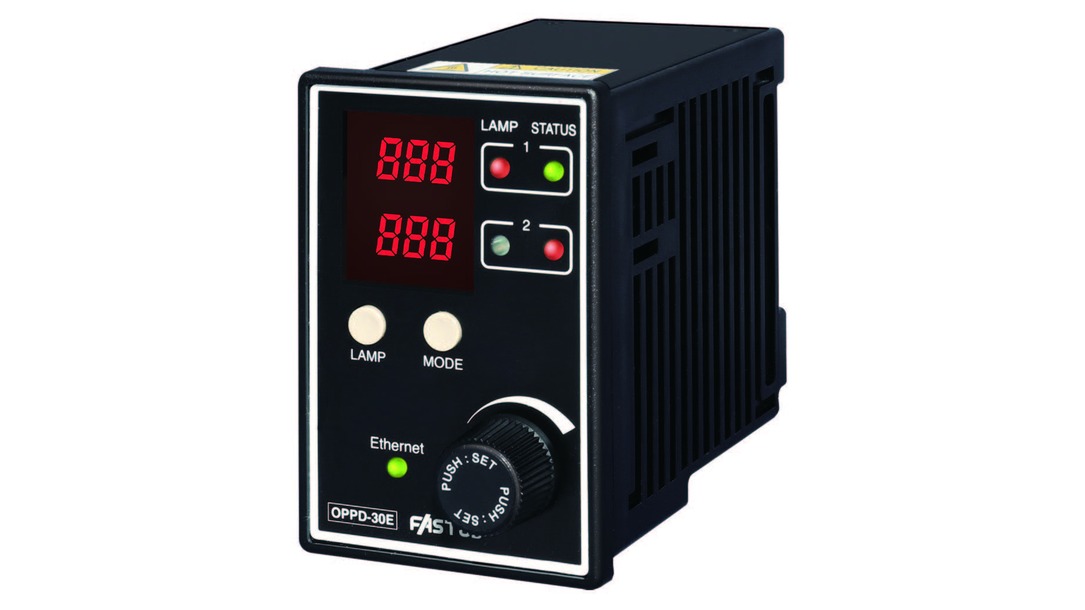
The FASTUS OPPD-30E is an LED lighting controller with Ethernet connectivity that reduces the effort required for lighting control.
In addition to simple configuration of dimming and illumination lighting control from a PC or a PLC, the OPPD-30E is also compatible with Mitsubishi Electric’s iQSS systems and can be used in a variety of engineering environments in the manufacturing field.
The OPPD-30E also makes it easy to catch decreases in lighting brightness, allowing for predictive lighting maintenance through IoT (Internet of Things) setups.
Simple dimming and illumination control through Ethernet communication
Connecting is simple.just plug in a LAN cable!
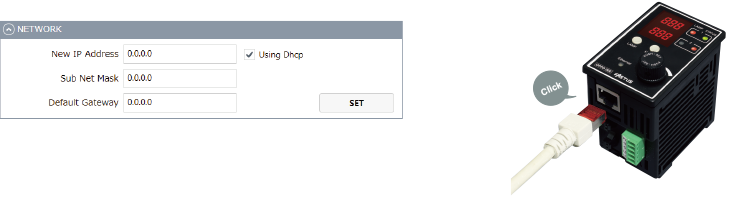
With support for DHCP, the OPPD-30E automatically obtains IP addresses and other information necessary for connection.
Manual configuration of network settings required with conventional models is unnecessary, and communication can be easily established simply by connecting a LAN cable within a DHCP server network environment.
High-speed communication
-
With the OPPD-30E, dimming values can be rewritten for both channels in about 6 ms.
-

Simple PC software-based setup
-
Dedicated PC software is available for the OPPD-30E. This software can be used to configure dimming, illumination control and frequency, among other aspects.
Access the OPTEX FA homepage to download the software for free. -

Intuitively operable interface
The software interface has been developed so that dimming and illumination control can be seen at a glance.
Settings can be easily configured through pull-down menus or through direct input.

Mitsubishi Electric iQSS support iQSS: iQ Sensor Solution
The OPPD-30E can be operated over networks using Mitsubishi Electric’s GX Works2.
Through connection and cooperation among image-processing lighting, power supplies, PLCs, displays, and other control equipment, batch management is possible and workability can be increased.

Compact size
Thanks to high-density mounting technology and an optimal heat dissipation design, the OPPD-30E boasts a size just 38% that of OPPF Series products.

New lighting control features
Illumination control input allocation function

With conventional models, one lighting output is allocated per controller input.
With the OPPD-30E, users can switch between one or two lighting units for every input at the controller.
In addition to reducing the number of wiring, the OPPD-30E enables flexible input changes even after wiring has been completed.


Lighting control sequence
With the OPPD-30E, up to four illumination setting patterns including dimming values can be configured.
Each pattern can be configured in an illumination control sequence with ordered switching for each illumination control input.(Lighting delay time settings are shared.)
With dimming values and illumination widths set in advance, automatic switching is only performed for illumination control input,allowing the time required for changing settings to be kept to a minimum.
With conventional models, control is not possible without using a PLC and setting up complex ladders.
With the OPPD-30E, such control can be achieved with no other equipment required.

Automatic brightness management and predictive lighting maintenance

Brightness/temperature monitoring and feedback control
-
Connecting the OPPD-30E to lighting equipped with “FALUX sensing”enables monitoring of the lighting brightness and temperature. Based on these monitored values, dimming feedback control can be performed, allowing brightness to be kept constant.
-

Monitoring function
The lighting’s built-in photodiodes are used to monitor the brightness of the lighting.
Alarm output: Setting a threshold in advance makes it possible to output an alarm when brightness decreases to a predetermined level.
Instrumental error adjustment: Absolute brightness monitoring makes it possible to adjust for lighting instrumental errors.
Dimming feedback control
Automatic brightness management
With LED lighting, decreases in brightness can occur due to various factors including drops in voltage caused by extension cables and LED deterioration.
The factory default brightness is maintained through automatically corrected dimming values to prevent drops in brightness.
Corrections can be verified as “Corrected dimming value.”The feedback range is determined by the set dimming value and the maximum dimming value (999).
A signal is output as a feedback error when the maximum dimming value is reached.

Measured brightness/temperature logging function
-
Measured values such as brightness and temperature can be collected and displayed in a graph using the dedicated software (PC).
Data can be output as a .csv file. Displaying monitored values allows users to recognize LED degradation, which is useful as a function for predictive lighting maintenance.Recordable items
・Dimming value ・Monitored value
・Corrected dimming value
・Lighting temperature
・Power supply temperature -

Contact Us
Our experts quickly deliver the best plan for your needs and provide continuous support throughout the process.
- Download List
- 20