

Basic Knowledge of IO-Link
Basic Knowledge of IO-Link
This section provides an easy-to-understand overview of IO-Link, its features and benefits.
What is IO-Link?
IO-Link is an industrial interface standard (IEC 61131-9) that connects sensors and actuators. This communication technology enables the exchange of various types of data, which have been managed manually one by one, at the sensor level in line with IIoT.
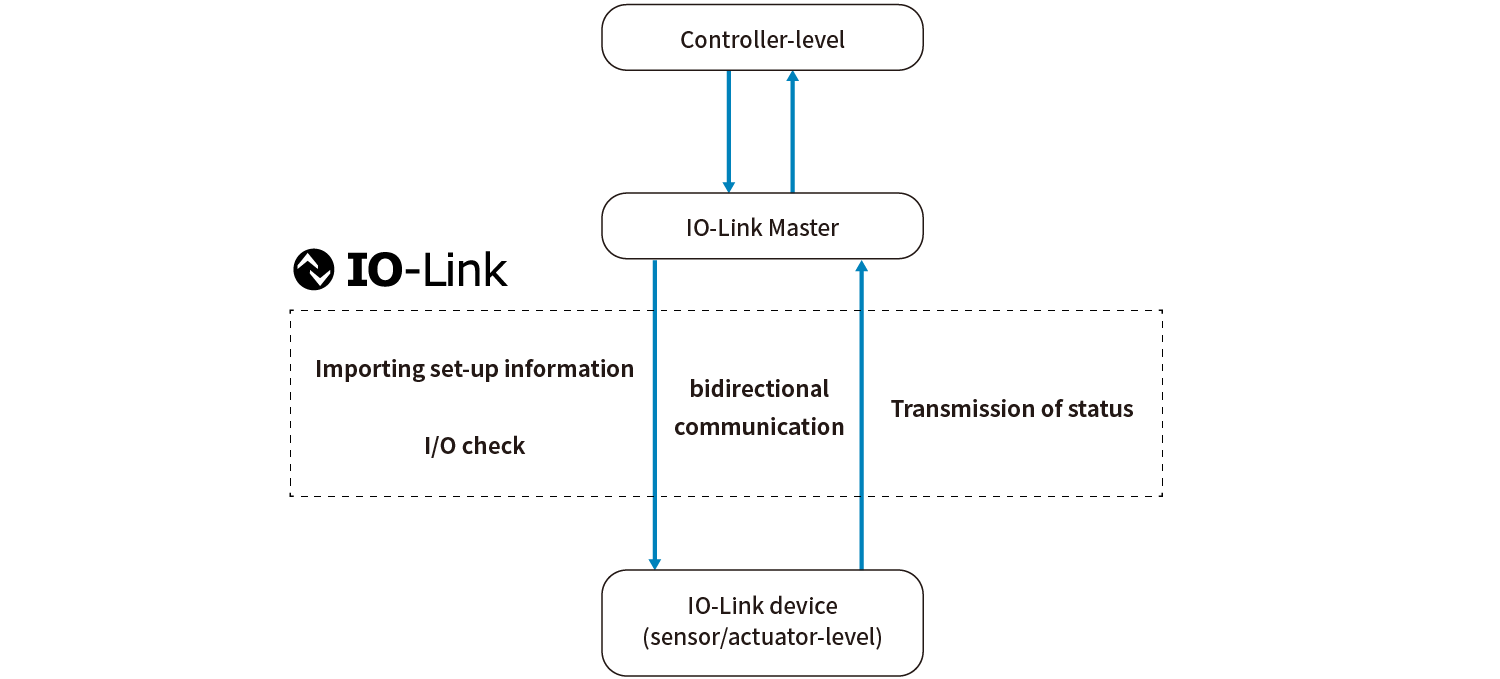
IO-Link compatible sensors and actuators are called IO-Link devices, which are connected to various industrial networks such as EtherNet/IP, EtherCAT, PROFINET, Modbus TCP, CC-Link IE TSN, CC-Link IE Field and CC-Link IE Field Basic through the IO-Link Master.
Sensors and actuators are connected to the IO-Link Master point-to-point, and are connected to controllers such as PLCs via industrial Ethernet.
|
POINT Accelerate IIoT by accessing various data from sensors and actuators. |
Main Features
Data Acquisition
In recent years, there has been an increasing need to digitize data from analog devices and incorporate it into systems. For this purpose, conventional devices are replaced with IO-Link devices. This is expected to reduce the number of devices such as A/D converters or lower the cost of devices.
Conventionally, at the sensor and actuator-level, ON/OFF signals, analog signals, and serial communications were wired separately. The IO-Link standardizes these processes, enabling more efficient operation.
At the same time, the following issues related to the use of analog I/O signals can also be solved.
- Change in measured values due to noise
- Convert errors during A/D or D/A conversion
- Scaling man-hours
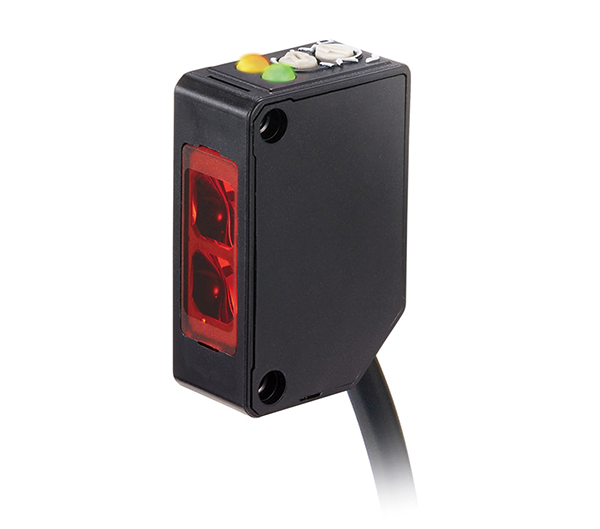
Conventional Device
|
1bit
|
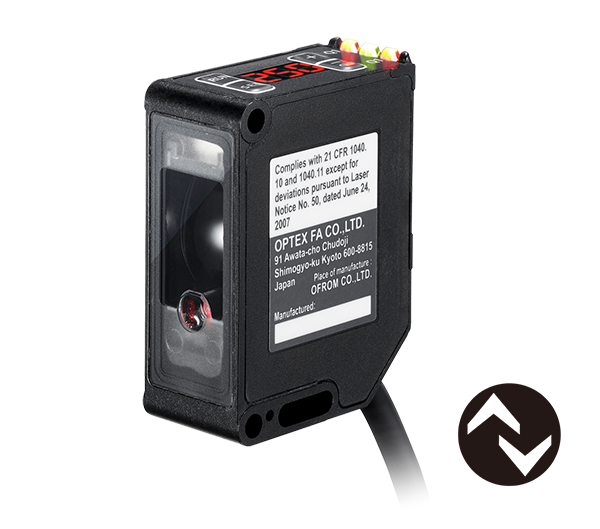
IO-Link Device
|
Max, 32bytes
|
| Process Data | Value Status | Device Data | Event |
|---|---|---|---|
|
|
|
|
|
POINT This enables visualization of data that could not be obtained before and detection of system abnormalities and failures. |
Making Machine and Plant Maintenance More Efficient
Since the parameters once set can be backed up to the IO-Link Master, it is possible to avoid problems such as wrong model if the IO-Link device is replaced with one of the same model.
In addition, set-up information can be imported from IO-Link Master when replacing IO-Link devices, eliminating the need to fine-tuning.
The IO-Link Master can back up not only the profile of each IO-Link device, but also the setting information after various parameter adjustments.
If the IO-Link device is replaced with one of the same model, the setting information can be restored to avoid different information than before.
Time Savings and Predictive Maintenance
In a factory, there are thousands of sensors and actuators operating on production lines and equipment, and IO-Link makes it possible to monitor and setup information from many sensors and actuators that could not be centrally managed in the past, at the controller-level.
The data that can be handled by IO-Link communication is shown on the left for a sensor.
Data Types Handled by IO-Link Communication
| Process Data | received light amount, distance, temperature, etc. |
|---|---|
| Status | Sensor Status |
| Parameter | vendor name, model, serial number, etc. |
| Events | maintenance information, errors |
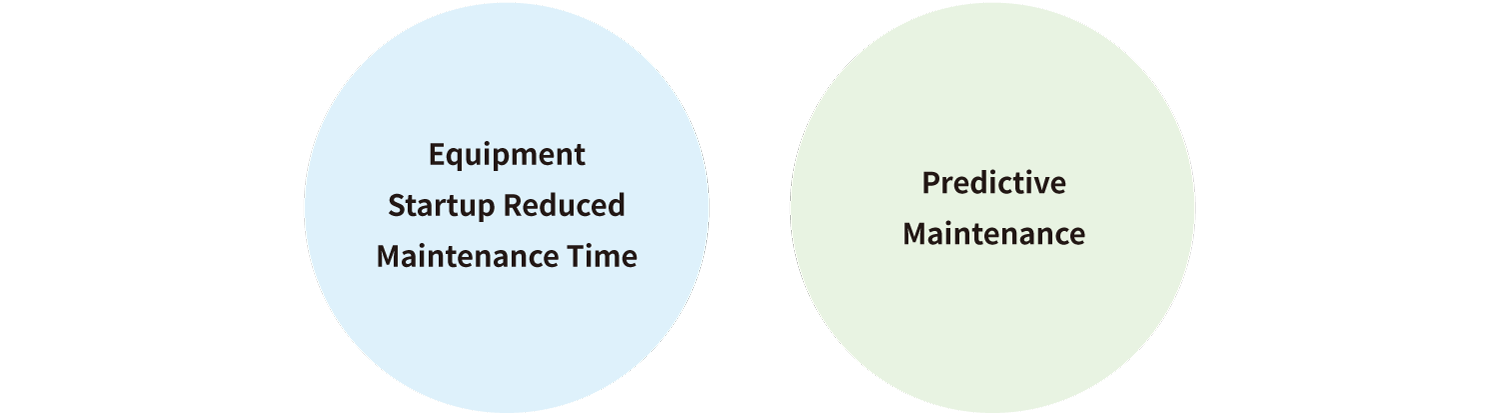
When changing lots or types, batch sensor settings and I/O checks can be performed from the PLC, and set-up information can be imported from IO-Link Master when replacing sensors. As a result, equipment start-up and maintenance time can be reduced.
In recent years, there has been an increasing need for "preventive maintenance" to detect signs of equipment failure. Many IO-Link devices are pre-installed with these functions, making it possible to easily create "preventive maintenance" systems.
|
POINT IO-Link reduces equipment start-up and maintenance time. |
Number and Type of IO-Link Devices
There are 16 million IO-Link devices as of the end of 2019.
The number of nodes has approximately doubled in two years from 8.1 million at the end of 2017.
There is a wide range of IO-Link devices.
Example: photoelectric sensors, displacement sensors, switches, RFID, actuators (driving devices), buzzers, indicator lights, etc.
- Download List
- 20