

Correct Use
This product cannot be used as a safety device to protect human body.
-
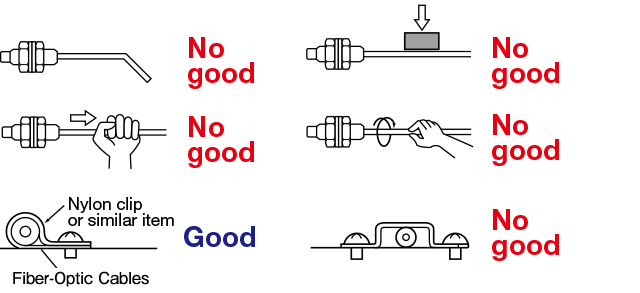
1. Do not hit or damage the detection head surface.

-
2. Do not bend or apply excessive force to the fiber.
-
3. Do not apply excessive torque to the sensor head or use tools that do not match the nuts.

-
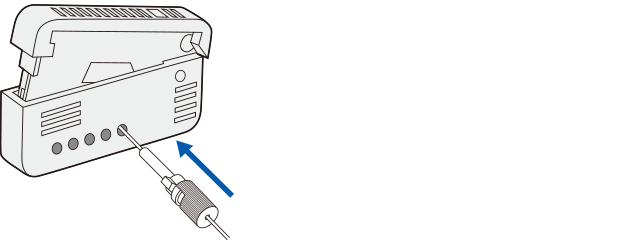
4. Do not twist in the gaps between the fiber cable and fiber adapter.

-
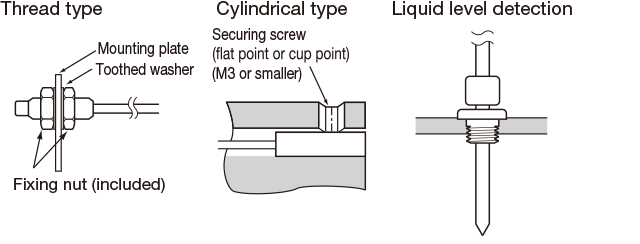
5. Depending on the bore shape of the sensor head, mount as shown in the diagrams below.
-
6. In the case of Fiber-Optic Cables that can be free cut, cut the tip with special fiber cutters before mounting to the Fiber-Optic Sensors.
-
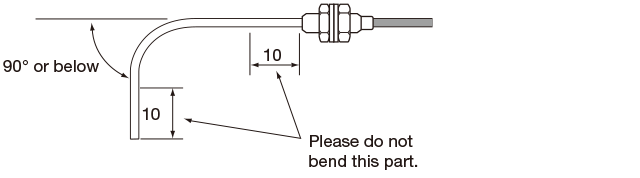
7. The Fiber-Optic Cables bending radius should be greater than the allowable bending radius. Excessive bending will shorted the sensing distance.

-
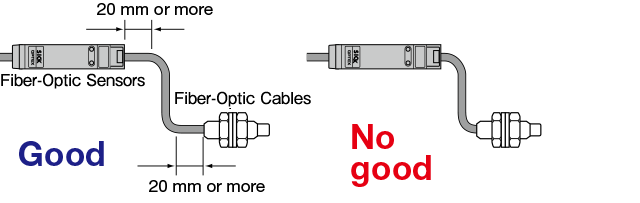
8. Allow for some wire to remain straight near the insertion and tip parts of the Fiber-Optic Cables.
-
9. Because sensing distance may decrease by as much as 20% depending on the conditions of cut surface of the fiber or connection conditions with the Fiber-Optic Sensors, we recommend using with sensing distance set at 80% or below.
-
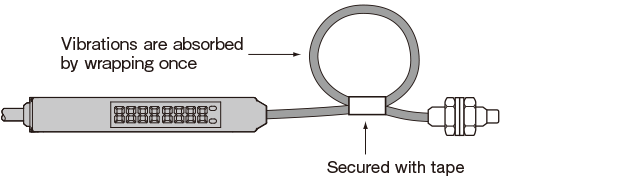
10. In areas subject to frequent vibration, secure so that the Fiber-Optic Cables itself will not vibrate. Especially work to limit vibrations from reaching connection points between the fiber and Fiber-Optic Sensors.
-
11. Use the method shown below to soften fiber head vibrations.
-
12. Do not use Fiber-Optic Cables not protected with fluoroplastic in environments where organic solvents are used.
-
13. Do not bend the sleeve tip or base.
Regarding fiber cutters Cutting procedure
-
1. Adjust the length in the direction of the arrow, turn the stopper and lock the fiber in place.

-
2. Insert the fiber into the fiber cutter and cut it.
-
3. The procedure is complete. (Correctly cut fiber)

- Download List
- 20